Artificial intelligence is becoming increasingly visible in structural engineering, but the discussion is often framed badly. At one extreme, AI is presented as something that will soon design structures automatically. At the other, it is dismissed as unsuitable for serious engineering work.
The more useful question is:
Which parts of structural engineering can benefit from AI, and which parts must remain under the control of the engineer?
Structural engineering is not simply a sequence of calculations. Engineers must understand load paths, represent the real structure analytically, identify failure modes, interpret standards, recognise numerical limitations and decide whether a result is technically defensible. AI can support that process, but it should not be confused with the process itself.
AI Is Not One Engineering Tool
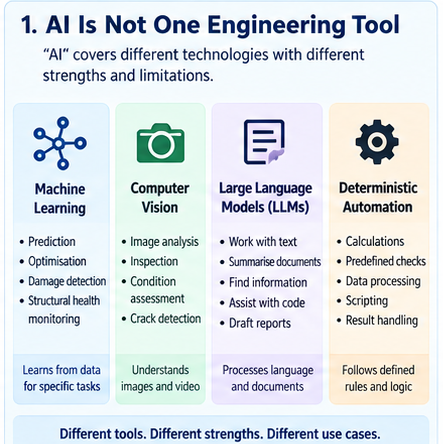
The term “AI” covers very different technologies. Machine-learning models can be trained for narrow engineering applications such as response prediction, damage detection or optimisation. Computer vision can assist with inspection. Large language models can work with technical text, tables and code.
These tools have different strengths and reliability. A validated model for a narrowly defined problem is fundamentally different from asking a general-purpose language model, “Is this structure safe?”
The credible use of AI is therefore not to hand over the engineering decision. It is to use AI where it is good at processing information while keeping structural reasoning and technical responsibility with the engineer.
Structural Engineering Is More Than Calculation
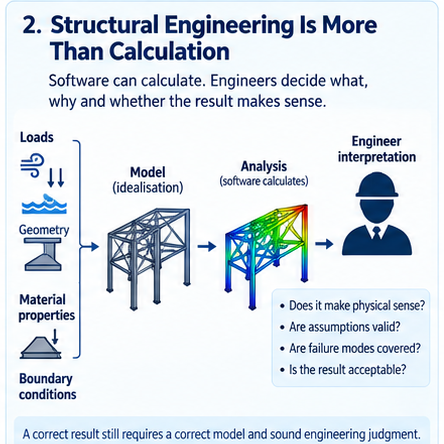
Modern FEA software can solve models with enormous numbers of elements and load combinations, but the software does not understand the structure.
The engineer still decides what should be modelled, which assumptions are reasonable, how loads and boundary conditions are represented, which failure modes are relevant and whether the calculated response makes physical sense.
A highly accurate numerical solution to a poor model is still a poor engineering result.
AI should be treated in much the same way. A convincing technical explanation is not automatically a correct one. The quality of the engineering still depends on assumptions, evidence, verification and judgment.
A Better Approach: Put AI Around the Engineering
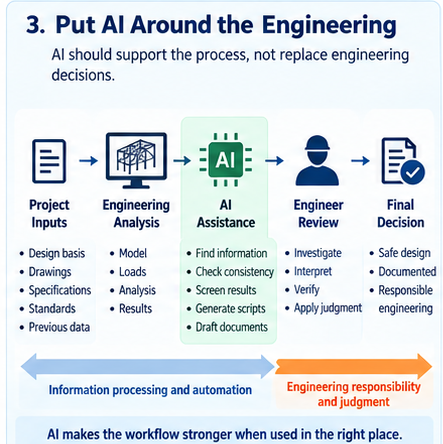
A practical workflow is:
Project Inputs → Engineering Analysis → AI Assistance → Engineer Review and Judgment → Final Engineering Decision
AI sits inside the engineering workflow. It does not sit above it.
1. Searching Engineering Documents
Structural projects may contain design bases, drawings, specifications, load schedules, standards, FEA reports, calculations and revision comments. Finding a requirement across that material can consume significant engineering time.
AI-assisted search can help locate information quickly. For example, it can identify every passage related to fatigue design and return the document, section and location.
But finding a requirement is not the same as interpreting it. The engineer must still determine whether the requirement applies and how it should be used.
AI can help find the requirement. The controlled engineering document remains the authority.
2. Checking Consistency Across Engineering Documents
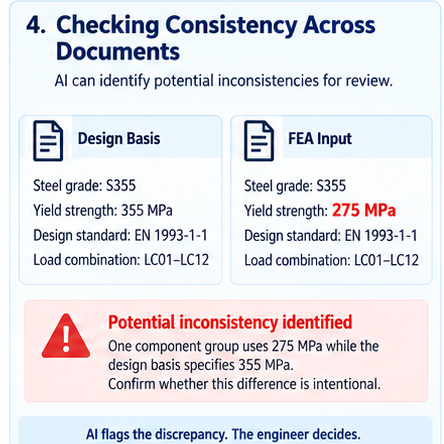
One of the most practical uses of AI is comparing information across a calculation package.
Suppose the design basis specifies S355, while an analysis input uses a yield strength of 275 MPa for one component group. A useful system should not decide which value is correct. It should flag the discrepancy:
Potential inconsistency: one component group uses 275 MPa while the design basis specifies S355. Confirm whether this difference is intentional.
The same approach can identify a load combination missing from a report, inconsistent plate thicknesses between drawings, outdated revisions or a mismatch between reported and tabulated utilisation.
These are simple problems, but they occur in real engineering work. Automation can help find them earlier.
3. Screening FEA Results
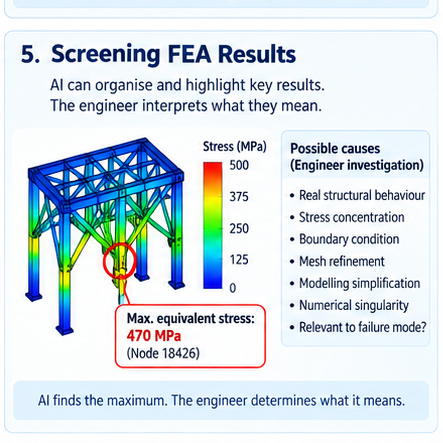
Large FEA models can generate millions of results. Automation can rank governing load combinations, identify high utilisation, compare model revisions, check reactions and highlight unusual displacements or stresses.
But finding a maximum value is very different from understanding what it represents.
A reported equivalent stress of 470 MPa near a fixed support does not, by itself, prove that the structure has failed. The engineer may need to determine whether the peak is caused by real structural behaviour, a local stress concentration, contact, mesh refinement, an idealised boundary condition or a numerical singularity.
The machine can identify where the maximum occurs. The structural engineer determines what the maximum means.
4. Automating Engineering Sanity Checks
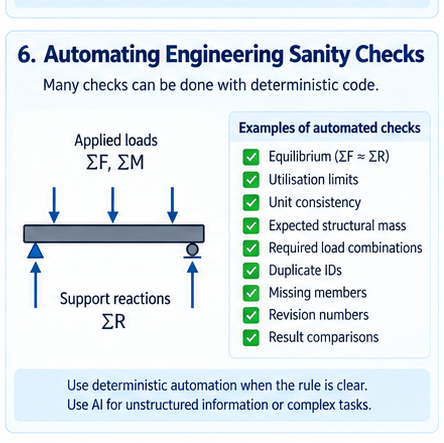
Not every automation problem needs AI. If a requirement can be expressed clearly as mathematics or logic, deterministic code is usually preferable.
For a static model, a simple script can check equilibrium:
and, where relevant:
The same principle applies to utilisation limits, units, expected structural mass, required load combinations, duplicate IDs, revision numbers and numerical comparisons.
Use deterministic engineering logic when the rule is deterministic. Use AI when the information is unstructured or difficult to express through fixed rules.
5. Generating Engineering Scripts
AI can be useful for programming repetitive engineering tasks. An engineer might ask it to draft a Python script that reads analysis results, groups them by member, identifies governing load combinations and produces a summary table.
That can save time, but formulas, units, sign conventions, indexing, filtering and boundary cases still need verification.
A safer workflow is:
Engineer defines method → AI drafts code → Engineer reviews → Benchmark against known results → Use
A small manually verified test case can reveal serious implementation errors before a script is applied to thousands of results.
6. Navigating Design Standards
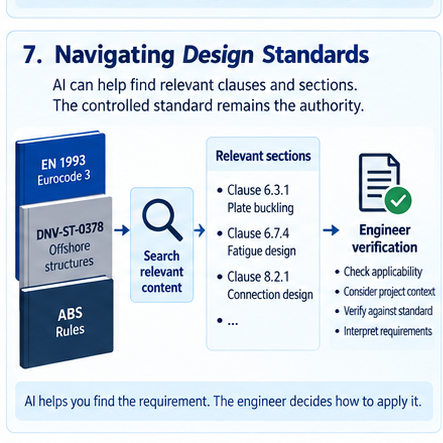
Structural engineers work with Eurocodes, offshore standards, classification rules, client specifications and project-specific design bases. AI can help search these documents for topics such as plate buckling or fatigue life.
The danger begins when a model is asked for a specific clause, equation or allowable value without reliable access to the controlled document. Language models can produce convincing but incorrect references.
AI should help navigate standards, not become the standard.
Critical requirements should always be verified directly against the applicable controlled document.
7. Drafting Calculation Reports
Technical reports contain repetitive descriptions of geometry, materials, load cases, analysis methods and results. AI can help turn existing engineering information into a first draft.
What it cannot do is create engineering justification that was never established. The engineer still has to explain why the model is appropriate, why assumptions were selected, what limitations exist and why the results are acceptable.
Polished language is useful. Defensible engineering reasoning is considerably more useful.
A Practical Structural Engineering Example
Consider a steel support structure where the design basis, load combinations, FEA and connection checks are already complete. An AI-assisted review could extract material grades and design criteria, while deterministic scripts screen displacement, utilisation, support reactions and stresses.
The combined review might flag:
- LC09 appears in the result file but not in the calculation report;
- the conclusion reports utilisation 0.84 while the result database contains 0.89;
- one component uses a material property different from the design basis;
- the maximum stress occurs near a constrained region and should be reviewed for modelling sensitivity.
Those are useful findings, but they are not engineering conclusions. Each may have a valid explanation.
The system identifies possible problems. The engineer decides whether they are actually problems.
Three Practical Levels of AI Use
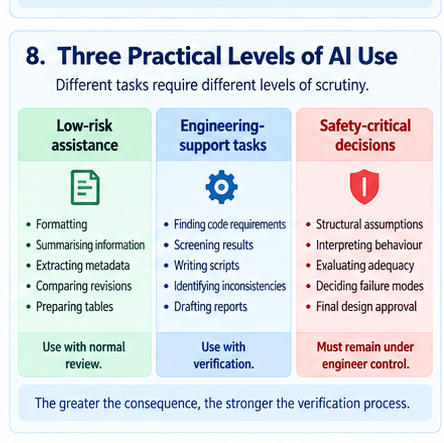
Low-risk assistance
Formatting, summarising supplied information, extracting metadata, comparing revisions and preparing tables. AI can be used relatively freely, provided the output is reviewed.
Engineering-support tasks
Finding code requirements, screening analysis results, writing scripts, identifying inconsistencies and drafting reports. AI can assist, but important outputs should be independently verified.
Safety-critical engineering decisions
Selecting structural assumptions, defining failure modes, interpreting unusual behaviour, deciding structural adequacy and final design approval must remain under competent engineering control.
The greater the consequence of an incorrect result, the stronger the verification process should be.
Two Boundaries That Matter
AI review is not independent checking
If the same AI system helped develop a calculation, using it again does not automatically create an independent check. It may repeat the same assumptions or reasoning. Important engineering work still benefits from competent independent scrutiny.
Confidentiality matters
Engineering documents may contain proprietary drawings, client information, infrastructure details, inspection data and confidential specifications. Uploading them to a public AI service may not be permitted. Data ownership, cybersecurity, storage, contractual requirements and access control must be considered.
AI May Increase the Value of Engineering Judgment
Spreadsheets automated large amounts of manual calculation. FEA automated much more. Structural engineering did not disappear. Instead, the important questions shifted toward what should be calculated and whether the result makes physical sense.
AI may create another version of the same transition. If engineers spend less time searching documents, sorting results, comparing revisions and producing repetitive reports, they can spend more time on structural behaviour, load paths, stability, fatigue, robustness, failure mechanisms and uncertainty.
Those are precisely the areas where engineering experience matters most.
Four Questions Before Using AI
- Can this task be solved with deterministic automation? If yes, conventional code may be more reliable.
- Can the output be independently verified? If it cannot reasonably be checked, AI should not carry an important decision.
- What happens if the answer is wrong? Higher consequence requires stronger verification.
- Who makes the final engineering decision? For structural adequacy, that responsibility must remain clear.
The structural engineer.
Conclusion
The most useful application of AI in structural engineering is not asking a machine to become a structural engineer. It is building better tools around structural engineers.
AI can help search technical information, compare documents, organise analysis results, identify inconsistencies, generate scripts and automate repetitive quality-control tasks. Used properly, these tools can make engineering workflows faster and more systematic.
But loads must still be justified, models must represent reality, failure modes must be understood, standards must be interpreted correctly and results must be challenged.
Structural engineers using AI to spend less time processing information and more time understanding structures.
That is automation worth pursuing.
References
- The Institution of Structural Engineers. Implementing AI in Structural Engineering.
- The Institution of Structural Engineers. Calculation Models: Artificial Intelligence – Large Language Models.
- American Society of Civil Engineers. Policy Statement 573: Artificial Intelligence and Engineering Responsibility.
- Xie, H., Mei, Q. and Chui, Y.H. AI Applications for Structural Design Automation. Automation in Construction, 2025.
- Thai, H.-T. Machine Learning for Structural Engineering: A State-of-the-Art Review. Structures, 2022.
- National Institute of Standards and Technology. Artificial Intelligence Risk Management Framework (AI RMF).

ABOUT THE AUTHOR
Sepehr Rahili Khorasani
Senior Structural Engineer with experience in offshore and marine engineering, structural analysis and finite element analysis. Exploring practical digital tools that can improve engineering workflows while keeping engineering judgement at the centre of technical decisions.
View professional profile →